Showing posts with label EBooks. Show all posts

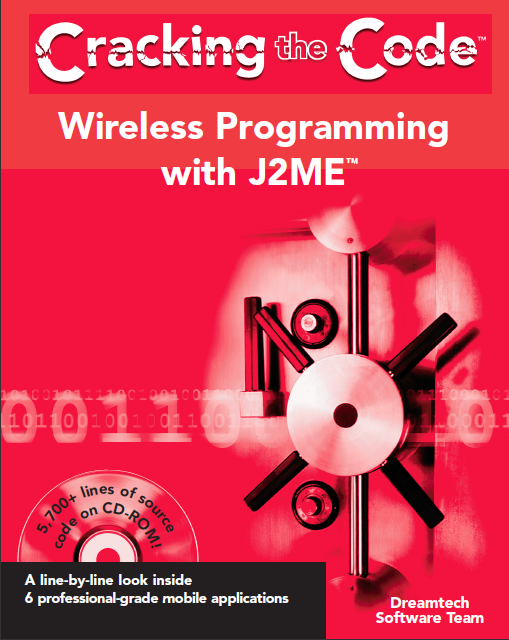
Wireless Programming with J2ME - Cracking the Code Free Download

0 comments
Wireless Programming with J2ME - Cracking the Code  Free Download

Wireless devices are new entrants in the information technology arena. As wireless devices are compact and easy to handle, the focus of information technology is rapidly shifted from PCs to PDAs, cellular phones and pagers. The market for these have undergone a tremendous growth over the past few years. The devices are becoming increasingly sophisticated in response to the demand for them to access the Net as well as computing devices. Moreover, these devices are paving the way for new business strategies.

Sun Microsystems fulfilled the aspirations of the java community by launching J2ME, which gave java an edge over other programming tools in its performance on wireless devices. It was first introduce at the Java One Conference in 1999. The J2ME has two “design centers”. Thus, this platform has two configurations and these are CLDC (Connected Limited Device Configuration) and CDC (Connected Device Configuration).

With an approach that is based on Configurations and Profiles, J2ME offers flexibility to developers, which is of great significance to for extremely diverse handheld and wireless devices. This approach makes it possible to provide as much functionality as the device has the potential to support. Added to this are the usual benefits of Java, such as portability across platforms, security and the object-oriented character. This is why Java is predicted to be the most preferred language for most computing devices.
It may well be said that J2ME is still in the early stages of development. Two configurations have been available, but only a few of the proposed profiles are available as of now. This situation is bound to change as soon as the Micro Edition platform becomes more mature which definitely will happen in near future.


Beside this small introduction about Java and J2ME, this book contains some stunning topics depicting the java programming for wireless devices. I found this book a complete package for newbies as well as professionals. I hope you will also learn and enhance you knowledge.


                                                           Free Download


Compilers Principles, Techniques, and Tools, 2nd Edition - Free Download

0 comments
Compilers Principles, Techniques, and Tools, 2nd Edition - Free Download


The world of compiler design has changed significantly. Programming languages have evolved to present new compilation problems. Computer architectures offer a variety of resources of which the compiler designer must take advantage. Perhaps most interestingly, the venerable technology of code optimization has found use outside compilers. It is now used in tools that and bugs in software, and most importantly, and security holes in existing code. And much of the front-end technology the grammars, regular expressions, parsers, and syntax-directed translators are still in wide use.

This book is very useful for the beginners and professionals as well. Beside all the core concepts this book also contains extensive exercises, with some for almost every section. The harder exercises or parts of exercises with an exclamation point. The hardest exercises have a double exclamation point. Here is an outline of the chapters included in this book.

Chapter 1 contains motivational material and also presents some background issues in computer architecture and programming-language principles.

Chapter 2 develops a miniature compiler and introduces many of the important concepts, which are then developed in later chapters. The compiler itself appears in the appendix.

Chapter 3 covers lexical analysis, regular expressions, finite-state machines, and scanner-generator tools. This material is fundamental to text-processing of all sorts.

Chapter 4 covers the major parsing methods, top-down (recursive-descent, LL) and bottom-up (LR and its variants).

Chapter 5 introduces the principal ideas in syntax-directed definitions and syntax-directed translations.

Chapter 6 takes the theory of Chapter 5 and shows how to use it to generate intermediate code for a typical programming language.

Chapter 7 covers run-time environments, especially management of the run-time stack and garbage collection.

Chapter 8 is on object-code generation. It covers construction of basic blocks, generation of code from expressions and basic blocks, and register-allocation techniques.

Chapter 9 introduces the technology of code optimization, including flow graphs, data-flow frameworks, and iterative algorithms for solving these frameworks.

Chapter 10 covers instruction-level optimization. The emphasis is on the extraction of parallelism from small sequences of instructions and scheduling them on single processors that can do more than one thing at once.

Chapter 11 talks about larger-scale parallelism detection and exploitation. Here, the emphasis is on numeric codes that have many tight loops that range over multidimensional arrays.


Chapter 12 is on inter-procedural analysis. It covers pointer analysis, aliasing, and data-flow analysis that takes into account the sequence of procedure calls that reach a given point in the code.

                                     
                                                           Free Download


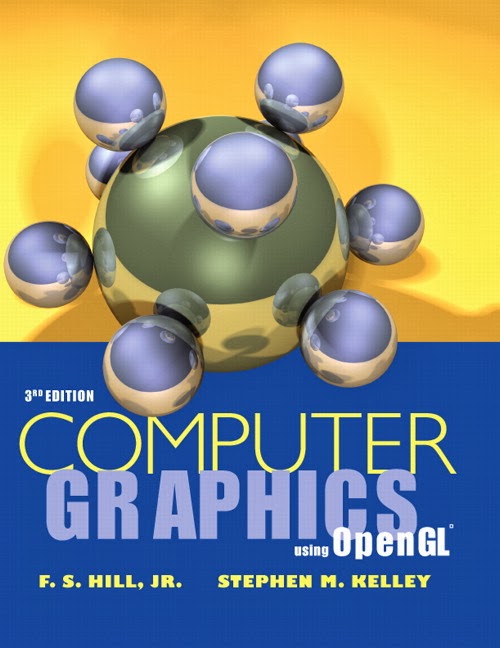
Computer Graphics Using OpenGL 3rd Edition by F.S HILL - Free Download

0 comments
                                      Computer Graphics 3rd Edition free download


Computer graphics is a very appealing field of study. You learn to write programs that create pictures, rather than streams of text or numbers. Humans respond readily to pictorial information, and are able to absorb much more information from pictures than from a collection of numbers. Our eye-brain systems are highly attuned to recognizing visual patterns. Reading text is of course one form of pattern recognition: we instantly recognize character shapes, form them into words, and interpret their meaning. But we are even more acute when glancing at a picture. What might be an inscrutable blather of numbers when presented as text becomes an instantly recognizable shape or pattern when presented graphically. The amount of information in a picture can be enormous. We not only recognize what’s “in it”, but also glean a world of information from its subtle details and texture.

As Compare to earlier editions (1st and 2nd) the authors made some additions in third edition. They add some new advance concepts and new exercise materials also. This books helps you to learn basics as well as advance concepts of Computer Graphics using 2D and 3D methods. The most cool thing in this book is the case studies which are included at the end of each chapter. I am going to mention its contents right here that will definitely helps you before reading this book.

Chapter 1      Introduction to Computer Graphics

What Is Computer Graphics?
Where Computer-Generated Pictures Are Used
Elements of Pictures Created in Computer Graphics
Graphics Display Devices
Graphics Input Primitives and Devices

Chapter 2      Initial Steps in Drawing Figures

To Get Started Making Pictures
The OpenGL Basic Graphics Primitives
Line Drawings in OpenGL
Simple Interaction with the Mouse and Keyboard
Introduction to the Design and Use of Menüs in an Application

Chapter 3      Additional Drawing Tools

World Windows and Viewports
Clipping Lines
Regular Polygons, Circles, and Ares
The Parametric Form for a Curve
Case Studies

Chapter 4      Vector Tools for Graphics

The Dot Product
The Cross Product of Two Vectors
Representations of Key Geometrie Objects
Polygon Intersection Problems

Chapter 5      Transformations of Objects

Introduction to Transformations
3D Affine Transformations
How To Change Coordinate Systems
Affine Transformations Used in a Program
To Draw 3D Scenes Interactively with OpenGL

Chapter 6      Modeling Shapes with Polygonal Meshes

Solid Modeling with Polygonal Meshes
Polyhedra
Extruded Shapes
Mesh Approximations to Smooth Objects
Particle Systems and Physically Based Systems

Chapter 7      Three-Dimensional Viewing

The Camera Revisited
To Specify a Camera in a Program
Perspective Projections of 3D Objects
To Produce Stereo Views
Taxonomy of Projections

Chapter 8      Rendering Facesfor Visual Realism

Introduction to Shading Models
Fiat Shading and Smooth Shading
Add Texture to Faces
OpenGL 2.0 & The Shading Language (GLSL)

Chapter 9      Tools for Raster Displays

Manipulating Pixmaps
Combining Pixmaps
Manipulating Symbolically Defined Regions
Filling Polygon-Defined Regions

Chapter 10      Curve and Surface Design

Bezier Curves for Curve Design
Finding Better Blending Functions
The B-Spline Basis Functions
Useful Properties of B-Spline Curves for Design
Rational Splines and NURBS Curves
A Glimpse at Interpolation
Modeling Curved Surfaces

Chapter 11      Color Theory

Color Description
The CIE Standard
Color Spaces
Indexed Color and the LUT
Color Quantization


Chapter 12      Introduction to Ray Tracing

Intersection of a Ray with an Object
Organizing a Ray Tracer Application
Adding Surface Texture
Antialiasing Ray Tracings
Adding Shadows for Greater Realism
 Reflections and Transparency
Compound Objects: Boolean Operations on Objects
Ray Tracing vs. Ray Casting


                                                      Free Download


Human Body - A visual guide

0 comments


Most of the people in the world which are not related to medical field don’t know much about the organization, action and maintenance of human body. This book is really an incredible visual guide which covers all the structural parts of the human body.

The author has divided this book into 3 parts as:
1. Organization
2. Action
3. Maintenance

In the first part of the book the starts by elaborating the life style of different tribes. After that the organization of the cells, organs, skin, hair, instructions and multiplications etc. are defines with their visual impacts.

The second part of this book shows the actions performed by different parts of our body. In this portion the author very well show and describe the actions and structure of our skulls, joints, muscles, hands and reflexes. All basic senses are also described in this portion. Moreover the he also described how our body language varies by our modes.

The last part of this book represents the maintenance of our body as it shows the blood, its circulation in our body and how heart pump our blood to make it possible to reach different parts of our body. You will also see the treatment and spare parts at the end of this book.
If you want to read the full book you can free download it from the below link:


www.dozenfiles.com


for more educational Ebooks stay tuned to CooLStack.

Solution to Computer Networking - A Top Down Approach - Free Download

0 comments

A few days ago i have posted a book of Computer Networking will free download facility. Now the solution of this book is provided in order to facilitate students to get assistance from it. The solutions are only helping material that helps you during exam preparation not for making assignments (like copy paste). I hope you will use it positively.
That's all.....

For free download click the following link, after clicking on the link you will land to Computer Science page now paste this name of the book as it is "solution_to_computer_networking_-_a_top-down_approach".
A download option will appear, click on it and download it.

Free Download 

for more free books stay tuned. You can also give us the name that you want. We will our best to provide you.

Computer Networking : A Top down Approach Featuring the Internet 3rd Edition - Free Download

0 comments
free book on computer networking

This textbook is very different than the other computer networking books that are currently available. Perhaps the most unique and innovative feature of this textbook is that it is online and accessible through a Web browser. I believe that online format has several things going for it.

First, an online text can be accessed from any browser in the world, so a student can gain access to the book at anytime from anyplace. Second, as all of us Internet enthusiasts know, much of the best material describing the intricacies of the Internet is in the Internet itself.

Another unusual feature of the text is its Internet focus. Most of the existing textbooks begin with a
broader perspective and address the Internet as just as one of many computer network technologies. We
instead put Internet protocols in the spotlight, and use the Internet protocols as motivation for studying
some of the more fundamental computer networking concepts.

I have found that modern-day students in computer science and electrical engineering, being intensive users of the Internet, are enormously curious about what is under the hood of the Internet. Thus, it is easy to get students excited about computer networking when using the Internet as your guiding vehicle. A second reason for the Internet focus is that in recent years computer networking has become synonymous with the Internet. T

his wasn't the case five-to-ten years ago, when there was a lot of talk about ATM LANs and applications direclty interfacing with ATM (without passing through TCP/IP). I have now reached the point where just
about all data traffic is carried over the Internet or intranets.

Furthermore, streaming audio and video have recently become commonplace in the Internet, and someday telephony may be too. Because our book has an Internet focus, it is organized around a five-layer Internet architecture rather than around the more traditional seven-layer OSI architecture.

For free Download this book click below link that will leads you to the computer science department as described in the previous post. Now type the name of the book in the search box and a new page will opens and a download button is given on that page.........

Free DOWNLOAD

Operating System Concepts 9th Edition - Free Download

0 comments
Free book of Operating system 9th edition


Operating systems are an essential part of any computer system. Similarly, a course on operating systems is an essential part of any computer science education. This field is undergoing rapid change, as computers are now prevalent in virtually every arena of day-to-day life from embedded devices in automobiles through the most sophisticated planning tools for governments and multinational firms. Yet the fundamental concepts remain fairly clear, and it is on these that we base this book.

This book is written for an introductory course in operating systems
at the junior or senior undergraduate level or at the first-year graduate level.We
hope that practitioners will also find it useful. It provides a clear description of
the concepts that underlie operating systems. 

As prerequisites, the author assumes that the reader is familiar with basic data structures, computer organization, and a high-level language, such as C or Java. The hardware topics required for an understanding of operating systems are covered in Chapter 1. For code examples, the author used predominantly C, with some Java, but the reader can still understand the algorithms without a thorough knowledge of these languages.

Concepts are presented using intuitive descriptions. Important theoretical
results are covered, but formal proofs are largely omitted. The bibliographical
notes at the end of each chapter contain pointers to research papers in which
results were first presented and proved, as well as references to recent material
for further reading. In place of proofs, figures and examples are used to suggest
why we should expect the result in question to be true.

The fundamental concepts and algorithms covered in the book are often
based on those used in both commercial and open-source operating systems.
Our aim is to present these concepts and algorithms in a general setting that
is not tied to one particular operating system. However, we present a large
number of examples that pertain to the most popular and the most innovative
operating systems, including Linux, Microsoft Windows, Apple Mac OS X, and
Solaris. We also include examples of both Android and iOS, currently the two
dominant mobile operating systems.

For free Download this book click below that will leads you to the computer science department of Dozenfiles. You type the name of this book in search box and another page will appear with download button. Just click on download button and enjoy with free download.....


Free Download

Control Systems Engineering 6th-edition - Free Download

0 comments
Free Book on Control System Engineering 6th Edition


This book introduces students to the theory and practice of control systems engineering. The text emphasizes the practical application of the subject to the analysis and design of feedback systems.

The study of control systems engineering is essential for students pursuing
degrees in electrical, mechanical, aerospace, biomedical, or chemical engineering. Control systems are found in a broad range of applications within these disciplines, from aircraft and spacecraft to robots and process control systems.

Control Systems Engineering is suitable for upper-division college and university engineering students and for those who wish to master the subject matter through self-study. The student using this text should have completed typical lower division courses in physics and mathematics through differential equations. Other required background material, including Laplace transforms and linear algebra, is incorporated in the text, either within chapter discussions or separately in the appendixes or on the book's Companion Web site. 

Control System Engineering is relatively a new field that gained a significant attention in 20th century. This book provides you a deep knowledge about control system and their navigation.


For free download you have to click the below on "Free Download". While going on the link you should go down to the page and click on "Slow Download". After that you downloading will start automatically.


Free Download

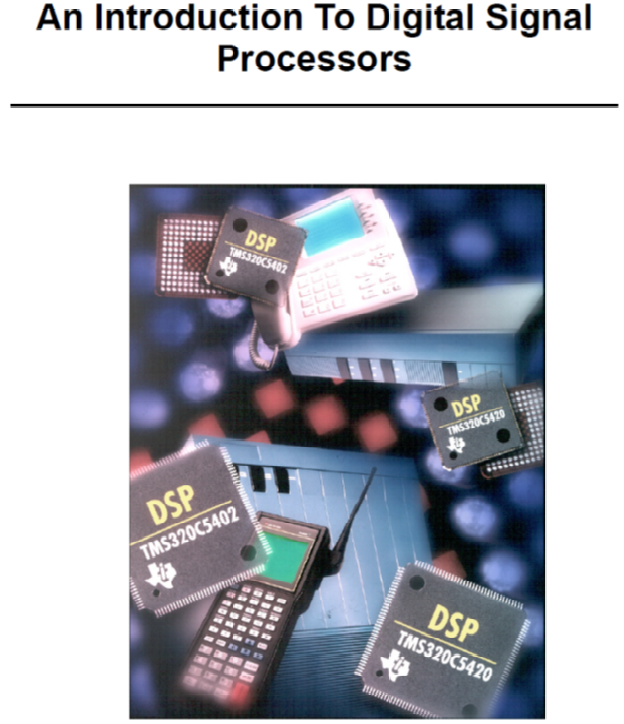
Introduction to Digital Signal Processors - Free Download

0 comments
Into to Digital Signal Processors

Charles Babbage invented the concept of computer in the mid 19th century, but the
concept had to wait for the development of vacuum tube electronics in the 1930s to
achieve its full potential.

The first electronic computer was actually built by Tommy Flowers, an electronics engineer in the British secret service, during the Second World War. This computer called Colossus was used by the British secret service to decipher German military codes. Because of the secrecy that surrounded these operations it was not recognized as the first electronic computer until recently.

A computer performs its task by the sequential execution of elementary binary
operations called “instructions”. These elementary instructions may represent the
addition of two numbers for instance, or a comparison between two numbers, or the
transfer of a binary word from one memory location to another. They are assembled in a
complete “program” that defines the global task carried out by the computer.
The part of the computer that executes the instructions is called the Central Processing
Unit (CPU).

A microprocessor is a silicon chip that implements the complete Central Processing Unit
of a computer. Silicon photolithographic and etching processes are used to massproduce
microprocessors.

The development of the microprocessor in the 1970’s represents a major milestone in
the history of electronics and computer systems. It enabled the development of low cost
computers, which in time became “personal computers”. It also spawned the field of
“embedded systems”, in which a microprocessor is used to control an electronic device
or subsystem. Nowadays, nearly all customer, scientific and industrial electronics
incorporate microprocessors.
Credit goes to author of this Book........

for free download click below....

Free Download

Introduction To Computers By Peter Norton - Free Download

0 comments
Free Book on Introduction to Computer

Computers are everywhere. Does it sound like an overstatement? A cliche? No matter how you perceive the impact of computers, the statement is true. Computers are everywhere. In fact, you can find them in some unlikely places, including your family car, your home appliances, and even your alarm clock!
In the past two decades, computers have reshaped our lives at home, work, and school. The vast majority of businesses now use computerized equipment in some way, and most companies are networked both internally and externally.

More than half of all homes in the United States have at least one computer, and most of them are connected to the Internet. Workers who once had little use for technology now interact with computers almost every minute of the workday. This lesson examines the many types of computers that are in common use today. Although this class will focus on personal computers (desktop), you w ill first learn about the wide variety of computers that people use, and the reasons they use them. As your knowledge of computers grows, you will understand that all computers regardless of their size or purpose, are basically similar. That is, they all operate on the same fundamental principles, are made from the same basic components, and need instructions to make them run.

This book provides you basic and well as detailed information about the computers and their types used now a days. This is indeed a very good and comprehensive book for beginners of computer.

You can free download this Book by clicking below..........
Free Download

Visual Basics 2012 - Free Download

0 comments
Free Book of Visual Basics


The Visual Studio development environment is an extremely powerful fifth-generation tool. It provides
graphical editors to make building forms and editing properties easy and intuitive; Intelli Sense
to help developers remember what to type next; auto-completion so developers can use meaningful
variable names without needing to waste time typing them completely by hand; tools that show
call hierarchies indicating which routines call which others; and breakpoints, watches, and other
advanced debugging tools that make building applications easier.

Visual Studio is so powerful that the answer to the question of whether you should use it is practically
obvious: If you want to write powerful applications that run in a Windows operating system,
you should use Visual Studio.

A Visual Basic programmer’s joke asks, “What’s the difference between Visual Basic .NET and C#?
About three months!” The implication is that Visual Basic .NET syntax is easier to understand and
building applications with it is faster. Similarly, C# programmers have their jokes about Visual Basic
.NET, implying that C# is more powerful.

In fact, Visual Basic .NET is not a whole lot easier to use than C#, and C# is not signifi cantly more
powerful. The basic form of the two languages is very similar. Aside from a few stylistic differences
(Visual Basic is line-oriented; C# uses lots of braces and semicolons), the languages are comparable.
Both use the Visual Studio development environment, both provide access to the .NET Framework
of support classes and tools, and both provide similar syntax for performing basic programming
tasks.

The main difference between these languages is one of style. If you have experience with previous
versions of Visual Basic, you will probably find Visual Basic 2012 easier to get used to. If you have
experience with C++ or Java, you will probably find C# (or Visual C++ or Visual J#) easy to learn.
Visual Basic does have some ties with other Microsoft products that increase its value. For example,
Active Server Pages (ASP) and ASP.NET use Visual Basic to create interactive web pages. 

Microsoft Office applications (Word, Excel, PowerPoint, and so forth) and many third-party tools use Visual
Basic for Applications (VBA) as a macro programming language. If you know Visual Basic, you
have a big head start in using these other languages. ASP and VBA are based on pre-.NET versions
of Visual Basic, so you won’t instantly know how to use them, but you’ll have an advantage if you
need to learn ASP or VBA.

If you are new to programming, either Visual Basic 2012 or C# is a good choice. I think Visual
Basic 2012 is a little easier to learn, but I may be slightly biased because I have been using Visual Basic
since long before C# was invented. You won’t be making a big mistake either way, and you can easily
switch later, if necessary.

Who Should Read This Book......?

This book is intended for programmers of all levels. It describes the Visual Basic 2012 language
from scratch, so you don’t need experience with previous versions of the language. The book also
covers many intermediate and advanced topics. It covers topics in enough depth that even experienced
developers will discover new tips, tricks, and language details. After you have mastered the
language, you may still find useful tidbits throughout the book, and the reference appendices will
help you look up easily forgotten details.

I hope you will find this book being revolutionary in .Net frame works.
Credit to author of this book....

Free Download

U can Free Download this book from visiting.................................
http://www.dozenfiles.com/WebSitePages/FileDownloadPage.aspx

Ajax with Asp.Net

0 comments
Ajax in Asp.Net


Ajax is a set of technologies that will revolutionize the way that web-based applications are designed. It revolutionizes the way that applications are used, provides users a responsive application, and provides developers with the alternatives for building their applications. We believe that this book will meet your needs regarding programming Ajax on the ASP.NET platform.
This book is for programmers who use ASP.NET and are just starting to use Ajax technologies. 

This book will assist developers working on ASP.NET-based applications who want to improve their applications and skills, by providing a background in Ajax for them before delving into how to apply Ajax to their applications.

People interested in this book will be developers who are working in the ASP.NET environment and are looking to create a more responsive and modern application using technologies that are very similar to the desktop methodologies. Developers who are looking to improve the user experience of their existing applications, develop new applications, develop internal line-of-business applications, and those who want to bulk up with the latest technology that developers all over the world are talking about will find what they are looking for here.

In order to free download this book visit the given below link.......

http://www.dozenfiles.com/WebSitePages/FileDownloadPage.aspx

Solution Manual of Computer Organization and Architecture 8th Ed

0 comments
Solution of Computer Organization and Architecture by William Stallings 8th edition

Students are always looking for solutions of some higher educational books. Here i have posted the solution manual of Computer Organization and Architecture which includes the complete exercises of the 8th edition. Instructors as well as students can use this solution manual for their educational purpose and one thing i must want to say that students use this manual for preparation purpose not to make assignments from this manual.
Wish you best of Luck.........!


You can download this manual from visiting the following link........
http://www.dozenfiles.com/WebSitePages/FileDownloadPage.aspx

Computer Organisation and Architecture 8th edition by William Stallings

0 comments

Free book of William Stallings on Computer Organization and Architecture

This book is about the structure and function of computers. Its purpose is to present, as
clearly and completely as possible, the nature and characteristics of modern-day computer
systems.
This task is challenging for several reasons. First, there is a tremendous variety of products
that can rightly claim the name of computer, from single-chip microprocessors costing a
few dollars to supercomputers costing tens of millions of dollars. Variety is exhibited not
only in cost, but also in size, performance, and application. Second, the rapid pace of change that has always characterized computer technology continues with no letup. These changes all aspects of computer technology, from the underlying integrated circuit technology used to construct computer components, to the increasing use of parallel organization concepts in combining those components.
In spite of the variety and pace of change in the computer field, certain fundamental
concepts apply consistently throughout. The application of these concepts depends on the
current state of the technology and the price/performance objectives of the designer.The intent of this book is to provide a thorough discussion of the fundamentals of computer organization and architecture and to relate these to contemporary design issues.
I have also read this book. This book indeed a great effort toward designing computer architectures. 

In order to direct download this book you can the following link
http://www.dozenfiles.com/WebSitePages/FileDownloadPage.aspx

Software Engineering 8th Edition by Ian Sommerville Free Download

0 comments

The basic structure of this book follows the essential software processes of specification,design, development, verification and validation, and management.
In order to download book please visit at
http://www.dozenfiles.com/WebSitePages/FileDownloadPage.aspx